

Share a reading about the olfactory environments…
This reading list explores the role of smells influencing our experiences with nature, landscape and built environment, not limited to the concept of smellscape. From sensory ethnography and historical research to material culture, design exploration and art practice, the readings offer theoretical insights, methodological tools, and case studies for understanding and engaging with the olfactory dimension of place.
About “Smellscape”
In the article “Smellscape”, Porteous (1985) conceptualises the study of smellscapes could include smell events, smell marks and nosewitness which could be explored through smellwalks conducting environmental assessment of smells through questionnaires and interviews. Henshaw (2013: 5) suggests smellscape could be ‘referring to the overall smell environment, but with the acknowledgement that as human beings, we are only capable of detecting this partially at any one point of time, although we may carry a mental image or memory of the smellscape in its totality.’ There are also other terms such as “scentscapes”, “odourscapes” and “olfactory geograhies”. Nevertheless, these concepts share the same theoretical grounding, emphasizing the between smells, smell sources, people and the space.

Henshaw, V., 2013. Urban smellscapes: Understanding and designing city smell environments. Routledge.
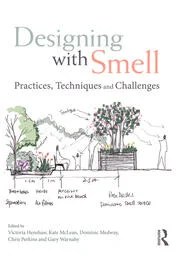
Henshaw, V., McLean, K., Medway, D., Perkins, C. and Warnaby, G. eds., 2017. Designing with smell: Practices, techniques and challenges. Routledge.
“…Where we have succeeded, for example with air conditioning systems for a large indoor communal spaces, the lack of any olfactory interest has been so profoundly disappointing that we have reintroduced artificial odours, like the ones to be found in our shopping malls…among the many kinds of wellbeing to which we aspire, we cannot forget our physical wellbeing, but neighter should we neglect our mental health or the health of our senses, such as the pleasure we tak in a particular scent or odour. ” p.276-277


A Glossary
Olfactory receptors
Nerve cells in the nasal smell organ that are responsible for receiving and transmitting information about smell.
Habituation/ Adaptation
Adaptation: A physiological process in which the olfactory receptors become less responsive to an odor after continuous exposure.
Habituation: A cognitive or central nervous system process where the brain learns to ignore a consistent smell that it perceives as non-threatening or irrelevant.
Masking effect
Masking occurs when a dominant smell interferes with the detection or recognition of another, typically weaker, smell in the environment. Because at the level of olfactory receptors, stronger odourant molecules occupy receptor sites, preventing weaker ones from being detected.
Anosmias / Hyposmia / Hyperosmia/ Dysosmia
Anosmia: temporary of permanent loss of the sense of smell.
Hyposmia: reduced ability to detect odors.
Hyperosmia: increased sensitivity to smells.
Dysosmia: a distorted sense of semll that is usually unpleasant.
List (continuing)
Please contact us if you wish to suggest a piece of reading to be added to the list!
Relevant publications from the team:
Torriani, G., Albatici, R., Babich, F., Vescovi, M., Zampini, M. and Torresin, S., 2025. Developing a principal components model of indoor smellscape perception in office buildings. Building and Environment, p.113044.https://www.sciencedirect.com/science/article/pii/S0360132325005256
Lygum, V.L. and Xiao, J., 2025. Creating Smellscapes with Plants: A Landscape Architectural Framework. Urban Science, 9(3), p.68. https://doi.org/10.3390/urbansci9030068
Lygum, V.L., 2017. Stop and Smell the Flowers: Plant Scent in a Healing Forest Garden for Patients with Stress-related Illness. In Designing with Smell (pp. 96-101). Routledge.
Lygum, V.L., Mathiasen, N. and Frandsen, A.K., 2025. The Nature Support Model for Dementia: a conceptual idea for green nursing home environments designed to support well-being throughout the last stages of dementia. Frontiers in Psychology, 16, p.1567619.
Balez, S., 2024. Fragrances architecturales. Hermann.
Balez, S., 2019. Enjeux éthiques des emprises olfactives et infraolfactives du conditionnement de l’air. Les Cahiers de la recherche architecturale urbaine et paysagère, (6).
Balez, S., 2021. Smell walks.
Experiential Walks for Urban Design: Revealing, Representing, and Activating the Sensory Environment , pp.93-114.
Xiao, J., Aletta, F., Radicchi, A., McLean, K., Shiner, L.E. and Verbeek, C., 2021. Recent advances in smellscape research for the built environment. Frontiers in psychology, 12, p.700514. https://doi.org/10.3389/fpsyg.2021.700514
Xiao, J., Tait, M. and Kang, J., 2020. Understanding smellscapes: Sense-making of smell-triggered emotions in place. Emotion, Space and Society, 37, p.100710. https://doi.org/10.1016/j.emospa.2020.100710
Balez, S., 2019. Ethical issues of the olfactory and infra-olfactory influence of air conditioning.
Notebooks of urban and landscape architectural research , (6). https://doi.org/10.4000/craup.2564
Xiao, J., Tait, M. and Kang, J., 2018. A perceptual model of smellscape pleasantness. Cities, 76, pp.105-115. https://doi.org/10.1016/j.cities.2018.01.013
Xiao, J., 2018. Smell, smellscape, and place-making: a review of approaches to study smellscape. Handbook of research on perception-driven approaches to urban assessment and design, pp.240-258. https://doi.org/10.4018/978-1-5225-3637-6.ch010.
Xiao, J., Tait, M. and Kang, J., 2017. The design of urban smellscapes with fragrant plants and water features. Designing with Smell, pp.83-95.
Bembibre, C. and Strlič, M., 2017. Smell of heritage: a framework for the identification, analysis and archival of historic odours. Heritage Science, 5, pp.1-11.
Bembibre, C. and Strlič, M., 2022. From smelly buildings to the scented past: An overview of olfactory heritage. Frontiers in Psychology, 12, p.718287. https://doi.org/10.3389/fpsyg.2021.718287
McLean, K., 2020. Temporalities of the smellscape: Creative mapping as visual representation. Modern approaches to the visualization of landscapes, pp.217-245.
McLean, K., 2017. Communicating and mediating smellscapes: the design and exposition of olfactory mappings. In Designing with Smell (pp. 67-77). Routledge.
Journal articles:
Porteous, J.D., 1985. Smellscape. Progress in Human Geography, 9(3), pp.356-378.
Press, D. and Minta, S.C., 2000. The smell of nature: Olfaction, knowledge and the environment. Ethics, Place and Environment, 3(2), pp.173-186.
Oleszkiewicz, A., Heyne, L., Sienkiewicz-Oleszkiewicz, B., Cuevas, M., Haehner, A. and Hummel, T., 2021. Odours count: human olfactory ecology appears to be helpful in the improvement of the sense of smell. Scientific Reports, 11(1), p.16888.
Bentley, P.R., Fisher, J.C., Dallimer, M., Fish, R.D., Austen, G.E., Irvine, K.N. and Davies, Z.G., 2023. Nature, smells, and human wellbeing. Ambio, 52(1), pp.1-14.
Bratman, G.N., Bembibre, C., Daily, G.C., Doty, R.L., Hummel, T., Jacobs, L.F., Kahn Jr, P.H., Lashus, C., Majid, A., Miller, J.D. and Oleszkiewicz, A., 2024. Nature and human well-being: The olfactory pathway. Science Advances, 10(20), p.eadn3028.
Parker, M., Spennemann, D.H. and Bond, J., 2024. Methodologies for smellwalks and scentwalks—a critical review. Chemical Senses, 49, p.bjae005.
Hoover, K.C., 2009. The geography of smell. Cartographica: The International Journal for Geographic Information and Geovisualization, 44(4), pp.237-239. https://doi.org/10.3138/carto.44.4.237
Dugan, H., 2008. Scent of a woman: performing the politics of smell in late medieval and early modern England. Journal of Medieval and Early Modern Studies, 38(2), pp.229-252.
Verbeek, C. and Van Campen, C., 2013. Inhaling memories: Smell and taste memories in art, science, and practice. The Senses and Society, 8(2), pp.133-148.
Verbeek, C., Leemans, I. and Fleming, B., 2022. How can scents enhance the impact of guided museum tours? Towards an impact approach for olfactory museology. The Senses and Society, 17(3), pp.315-342.
Verbeek, C., 2016. Surreal aroma’s.(Re) constructing the volatile heritage of Marcel Duchamp. RELIEF-Revue électronique de littérature française, 10(1), pp.133-142.
Spence, C., 2020. Using ambient scent to enhance well-being in the multisensory built environment. Frontiers in Psychology, 11, p.598859.
Spence, C., 2021. Scent in motion: On the multiple uses of ambient scent in the context of passenger transport. Frontiers in psychology, 12, p.702517.
Spence, C., 2020. Scent and the Cinema. i-Perception, 11(6), p.2041669520969710.
Spence, C., 2020. Using ambient scent to enhance well-being in the multisensory built environment. Frontiers in Psychology, 11, p.598859.
Spence, C., 2021. Scent in the context of live performance. i-Perception, 12(1), p.2041669520985537.
Spence, C., 2021. Musical scents: On the surprising absence of scented musical/auditory events, entertainments, and experiences. i-Perception, 12(5), p.20416695211038747.
Spence, C., 2020. Scenting the anosmic cube: On the use of ambient scent in the context of the art gallery or museum. i-Perception, 11(6), p.2041669520966628.
Books and chapters:
Classen, C., Howes, D. and Synnott, A., 2002. Aroma: The cultural history of smell. Routledge.
Drobnick, J. ed., 2006. The Smell Culture Reader. Berg.
Bradstreet, C., 2022. Scented Visions: Smell in Art, 1850-1914. Penn State Press.
Barbara, A. and Perliss, A. 2006. Invisible Architecture: Experiencing Places through the Sense of Smell. Skira Editore.
Engen, T., 2012. The perception of odors. Elsevier.
Reinarz, J., 2014. Past scents: Historical perspectives on smell. University of Illinois Press.
Erwine, B., 2016. Creating sensory spaces: The architecture of the invisible. Routledge.
Kiechle, M.A., 2017. Smell detectives: An olfactory history of nineteenth-century urban America. University of Washington Press.
Tullett, W., 2019. Smell in eighteenth-century England: a social sense. Oxford University Press.
Tullett, W., 2023. Smell and the Past: Noses, Archives, Narratives. Bloomsbury Academic.
Hsu, H.L., 2020. The smell of risk: Environmental disparities and olfactory aesthetics. In The Smell of Risk. New York University Press.
 Smellscape Catalogue: