
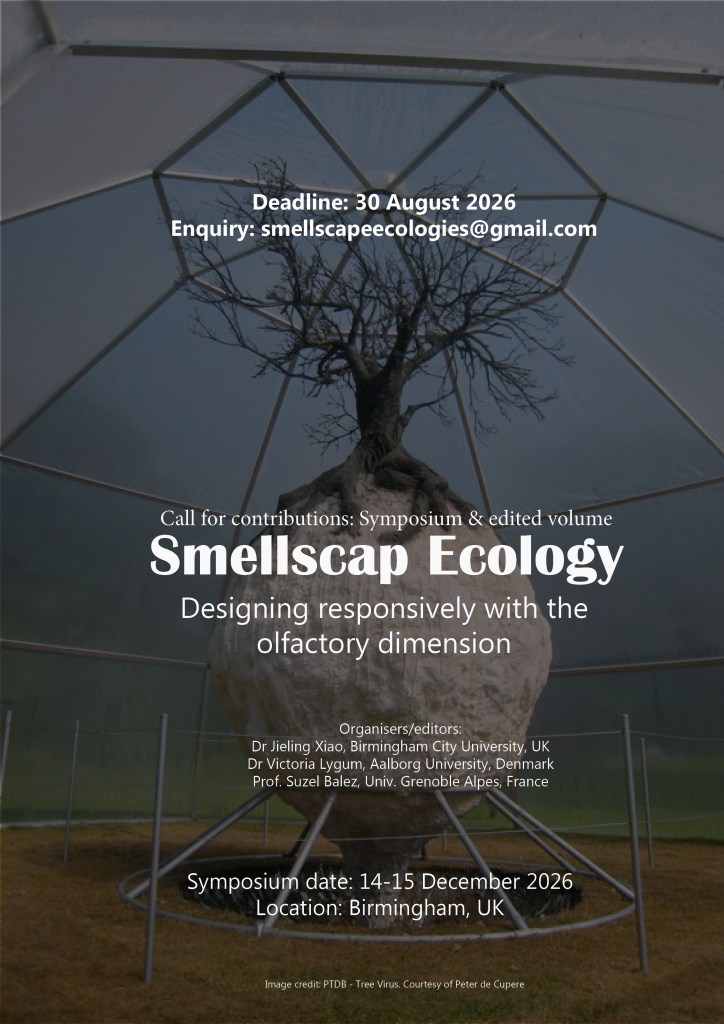
Smellscape Ecology: Designing Responsively with the Olfactory Dimension
Symposium date: 14-15 December 2026 Venue: Birmingham City University, Birmingham, UK.
Submission deadline has been extended to 30 September 2026. Enquiries: smellscapeecologies@gmail.com
Organisers/Editors: Dr Jieling Xiao, Birmingham City University, UK Dr Victoria Lygum, Aalborg University, Denmark Prof. Suzel Balez, Univ. Grenoble Alpes, France
About the Symposium
We invite paper proposals, practice presentations, and research-in-progress contributions for a symposium on smellscape ecology and its implications for responsible design of buildings, landscapes, and cities. The symposium offers an opportunity to discuss the concept and contribute to an edited volume on the theme.
The smellscape concept draws attention to the spatial and emotional connections between smells and humans in place, spanning across time and history. Here we consider smellscapes holistically, beyond the experiential dimension, looking at the perceptual quality of air grounded olfactorily. Air is not a neutral medium but a tool of spatial and bodily conditioning, where the manipulation or erasure of scent contributes to the governance of comfort and behaviour.
Climate change is already transforming the built and natural environments we inhabit and design. How are rising temperatures, shifting biodiversity, changing vegetation patterns, and urban air pollution altering the smellscape of streets, parks, interiors, and ecosystems? How do changed smellscapes affect human wellbeing, ecological functioning, and our sensory relationships with place and the non-human world?
Olfactory environments remain largely overlooked in architectural and urban research, design guidance, environmental history, and climate adaptation frameworks, raising urgent questions about who is responsible for protecting them, and for whom.
This symposium develops smellscape ecology as a new transdisciplinary framework for understanding olfactory environments and their relationship to ecological, climatic, cultural, and spatial change. Drawing from soundscape ecology, it proposes that olfactory environments are dynamic, spatially distributed systems shaped by cultural, biochemical, spatiotemporal, and perceptual processes, involving human and nonhuman actors alike. This reframes smell as design material, historical evidence, and ethical obligation to be mapped, designed, interpreted, measured, and responded to across time and across disciplines.
All contributions are expected to engage critically with the smellscape ecology concept and to ground their arguments in specific spatial contexts, whether at the scale of the building, the street, the landscape, or the city.
Thematic areas
We invite contributions across the following themes, and welcome proposals that cut across more than one.
Environmental History and Olfactory Change
How have olfactory environments in specific places and landscapes changed over time, and what can historical perspectives contribute to our understanding of smellscape ecology? We welcome contributions examining the long-term transformation of urban neighbourhoods, agricultural land, industrial sites, colonial landscapes, and other spatial contexts through the lens of olfactory change. How might historical methods — including archival research, oral history, and material culture — recover olfactory experiences of place that have been lost or suppressed? What do these spatial histories reveal about the relationship between olfactory environments, ecological change, power, and belonging?
Measuring and Monitoring Smellscape Ecology
What methods and tools are available for measuring and monitoring olfactory environments at the spatial and ecological scales relevant to architectural, landscape, and urban research? We welcome contributions that develop or critically evaluate approaches to olfactory fieldwork, ecological observation, and longitudinal monitoring of smellscape change across indoor environments, outdoor public and green spaces, and rural landscapes. How might qualitative, participatory, and community-based methods complement technical measurement to capture the full range of olfactory experience in a place?
Spatial Representation and Communication
How can olfactory environments be made legible, communicable, and designable through spatial representation? We particularly welcome work that develops drawing, mapping, notation, or diagrammatic languages for representing smellscapes at architectural and urban scales, as well as contributions that critically examine existing representational conventions and their limitations. How might the visual and spatial communication of olfactory environments support design decision-making, planning processes, and public engagement with climate-driven olfactory change?
Artistic Practice, Olfactory Aesthetics, and Ecology
How can artistic and creative practices contribute to our understanding of olfactory environments as ecological, aesthetic, and spatial systems? We welcome contributions from artists, designers, and creative practitioners working with scent, smell walks, sensory mapping, and site-specific olfactory installations, whose practice engages with questions of ecological change, place, memory, and multispecies relationships. What does an olfactory aesthetics grounded in spatial and ecological experience look like?
Olfactory Diversity, Equity, and Environmental Justice
How should architects, landscape architects, and planners respond to the olfactory consequences of climate adaptation measures, balancing multispecies olfactory functioning with human sensory wellbeing? Unequal access to restorative olfactory environments follows existing patterns of spatial inequality, and climate change is likely to intensify this unevenness. How do we account for olfactory diversity — biological, cultural, and experiential — in design decision-making across healthcare environments, social housing, public parks, and urban greenspace? How might participatory approaches ensure that the communities most affected by poor olfactory environments are centred in spatial planning and design decisions?
Policy, Standards, and Spatial Governance
How might smellscape ecology inform the spatial instruments through which built environment professionals shape cities and landscapes, including planning frameworks, building regulations, green infrastructure standards, and environmental impact assessment? What tools, standards, and interdisciplinary collaborations would enable climate responsibility for olfactory environments to be embedded in practice and policy at the scale of the neighbourhood, the city, and the region?
Contribution Formats
We welcome the following formats:
- Academic papers
- Datasets & Archives
- Multi-media work
- Workshops
- Design provocations
Work that combines scholarly rigour with strong spatial, visual, or illustrative dimensions is particularly encouraged.
How to submit?
Submit a 300-word abstract with the following:
- One image
- A short author biography
Please use the Google Form to submit your abstract. If you have any questions, please contact us at smellscapeecologies@gmail.com.
Note: Acceptance for the symposium does not automatically constitute acceptance for a book chapter; each is subject to independent review. Acceptance for book chapter consideration will be based on the originality and quality of the contribution, and how well it aligns with the emerging themes of the volume. Outcomes for book chapter submissions will be announced by 18 December 2026.
Deadline Extended to 30 September 2026!

